The global financial crisis of 2008 was a wake-up call for the world. But while many people were calling for updated regulations and even the breakup or nationalization of the big banks, it became clear to us that restoring long-term confidence in the financial services industry would require more than government intervention and new rules.
The world needed a profoundly new approach to governing the global economy, including a new modus operandi for financial services based on business principles like transparency, integrity and collaboration.
Evidence soon mounted that the crisis was spreading to other sectors. The Gulf Oil Spill, a sovereign debt crisis, the failure of world leaders to forge a meaningful agreement on climate change in Copenhagen. One event after another underscored the impotence of our conventional approaches to solving global problems. It seems that many of the institutions that have served us well for decades—even centuries—are frozen and unable to move forward.
And yet, through all of the haze and the turmoil we see cause for genuine optimism. In every corner of the globe, a powerful new model of economic and social innovation is sweeping across all sectors—one where people with drive, passion and expertise take
advantage of new Web-based tools to get more involved in making the world more prosperous, just and sustainable.
And just as millions have contributed to Wikipedia—and thousands still make ongoing contributions to large-scale collaborations like Linux and the human genome project—we are convinced that there is now an historic opportunity to marshal human skill, ingenuity and intelligence on a mass scale to re-evaluate and re-position many of our institutions for the coming decades and for future generations.
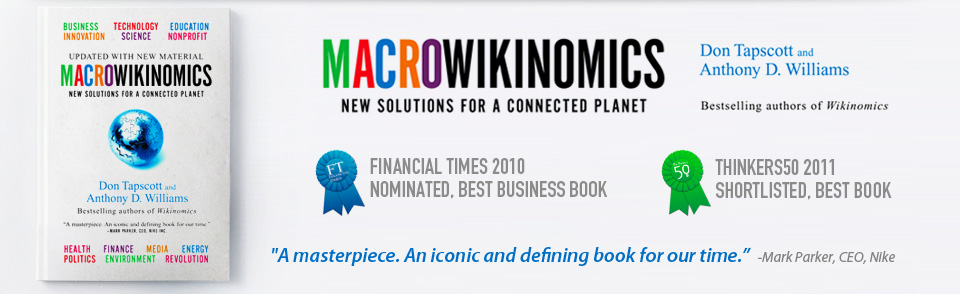
A follow-up to Wikinomics, the best-selling management book of 2007, our new book Macrowikinomics offers nothing less than a game plan for all of us to fix a broken world.
Drawing on an entirely new set of original research conducted with countless collaborators in fields such as healthcare, science, education, energy, government and the media, we tell the stories of some of the world’s most dynamic innovators, from a global citizen’s movement working to reverse the tide of disruptive climate change to for-profit startups that are turning industries ranging from music to transportation on their head.
We argue that collaborative innovation is not only transforming our economy but all of society and its many institutions. Now the onus is now on each of us to lead the transformation in our households, communities and workplaces. After all, the potential for new models of collaboration does not end with the production of software, media, entertainment and culture. Why not open source government, education, science, the production of energy, and even health care?
As this book shows, these are not idle fantasies, but real opportunities that the new world of wikinomics makes possible.

Traditionally, patients are passive recipients of medical care with little or no role to play in deciding their own treatments plans should they get sick. Patients are isolated from one another and rarely communicate or share knowledge. Healthcare occurs primarily when you enter the healthcare system. For many years, this was the only model possible. But Web 2.0 puts the informed patient into a new context. It enables a new model of medicine we call ‘collaborative healthcare.’
The global financial crisis destroyed long-term confidence in the financial services industry in the U.S. and other industrialized nations. We’re convinced that restoring confidence will require more than government intervention and new rules. What’s needed is an entirely new modus operandi for the financial services industry, one where all of the key players embrace the web, transparency and other wikinomics principles in order to develop credible practices and policies that will act as preventative measures.
Despite being a decade into the 21st Century, the unfortunate reality is that most governments still reflect industrial-age organizational thinking, and are based on the same command-and-control model as industrial-age enterprises. But the good news is that just as new waves of innovation are washing over the private sector, opportunities to harness new models of collaboration and innovation are arriving at the doorstep of governments everywhere.
We’re not talking about making some token efforts to widen the scope and scale of citizen participation in international forums. Nor are we proposing some grandiose vision of a representative global government or a new global bureaucracy. We’re talking about ordinary people getting together to create inclusive and participative forums for the generation of ideas and solutions to the most pressing problems facing the world.
Just as the Enlightenment ushered in a new organizational model of knowledge creation, the new Web is helping to transform the realm of science into an increasingly open and collaborative endeavor that will accelerate scientific discovery and learning. The Internet is not just a low-cost medium for disseminating scientific information; it’s the new platform for science, period.
Despite being a decade into the 21st Century, the unfortunate reality is that most governments still reflect industrial-age organizational thinking, and are based on the same command-and-control model as industrial-age enterprises. But the good news is that just as new waves of innovation are washing over the private sector, opportunities to harness new models of collaboration and innovation are arriving at the doorstep of governments everywhere.
The basic threat to traditional media today is not just that bits cost less than atoms. If plummeting costs were the only change, then media companies could exploit new technologies and become far more profitable using this new model. However, information produced and disseminated online behaves differently than physical books, magazines, and newspapers. With the new Web, the Internet is no longer about idly surfing and passively reading, listening, or watching.
Among the most daunting challenges facing humanity is the need to wean the world of its dangerous addiction to fossil fuels and build a new green energy economy that can sustain human civilization for centuries to come. The problem is that at the current pace of development we are still decades away from true mass-market deployment of any clean energy solutions, let alone all of them.
For the first time in history, individuals and small businesses can harness world-class capabilities, access markets, and serve customers in ways that only large corporations could in the past. Small and medium-size enterprises, for example, can make and sell products to a global market without having to manufacture anything themselves. Thanks to new services such as Ponoko, based in New Zealand, you can arrange to have your products manufactured and delivered directly to the customer, virtually anywhere in the world.